Configuring receivers with the correct technical values reduces the likelihood of missing channels or encountering weak signals. Each parameter—frequency, symbol rate, polarization, and FEC—plays a fundamental role in achieving stable reception. Proper tuning ensures that every scanned channel appears with sharp audio-visual quality.
Beyond frequency configuration, the physical aspects of installation cannot be overlooked. The satellite dish must be aligned precisely to the satellite’s orbital position to capture the strongest possible signal. Weather-resistant cables and clean connectors also help maintain long-term performance without interruptions.
By combining updated transponder information with a carefully installed satellite system, viewers unlock a smooth and uninterrupted viewing experience. With easy access to verified data, users can make confident adjustments and enjoy reliable broadcasting at all times.
Properly adjusting receiver settings based on updated parameters ensures a smooth channel-scanning process and reduces the likelihood of technical issues. The correct combination of frequency, symbol rate, and Forward Error Correction brings stronger signals and enhanced audio-visual clarity. This accuracy makes tuning more efficient and reliable.
Nonetheless, even perfect tuning cannot compensate for poor installation. A misaligned dish, damaged cables, or loose connectors can dramatically affect reception quality. Ensuring proper installation and routine maintenance helps maintain stable signal strength regardless of environmental conditions.
By pairing accurate technical updates with high-quality installation practices, users maximize their satellite system’s performance. This integrated approach guarantees clearer reception, faster channel recovery, and a
Tuning the satellite receiver with the correct parameters is key to avoiding common issues such as weak signals, incomplete scanning, or missing channels. Accurate entry of the frequency, symbol rate, and Forward Error Correction ensures a strong connection and stable performance. Proper configuration is essential for receiving clear and uninterrupted broadcasts.
The quality of the installation also plays a crucial role in the system’s overall performance. A precisely aligned dish, secure mounts, and well-insulated cables significantly improve signal strength and reduce interference. Maintaining these components helps achieve consistent reception regardless of environmental conditions.
Combining precise technical data with a proper installation setup results in a fully optimized satellite experience. Viewers benefit from strong, stable signals and seamless access to all channels, ensuring a more enjoyable viewing environment
Understanding how to enter the proper receiver settings helps viewers avoid many common issues, such as missing channels or weak signals. Frequency values, symbol rate, polarization, and Forward Error Correction must all be configured correctly to ensure clean signal reception and achieve the best possible picture and sound quality. This level of accuracy is what makes tuning both reliable and efficient.
The installation quality of the satellite dish also plays a major role in overall signal strength and stability, even when using the most up-to-date frequency data. Proper alignment, high-quality cables, and well-maintained receiver components significantly enhance performance and prevent interference, pixelation, or sudden signal drops.
By combining updated frequency information with proper technical installation, viewers can enjoy a fully optimized satellite experience. With the help of trusted resources like Channel Atlas, users gain greater control over their settings, restore channels quickly, and stay informed about the latest developments in the world of satellite broadcasting.
Accurate tuning begins with entering the correct frequency parameters into the receiver, including the updated transponder, symbol rate, and Forward Error Correction. These values work together to maintain strong reception and ensure that each channel appears clearly during the scanning process. When properly configured, users experience fewer issues related to signal drops or incomplete scans.
Technical installation also plays a major part in achieving stable and high-quality reception. Proper dish alignment, solid mounting, and clean signal pathways through high-quality cables contribute to minimizing interference and maintaining consistent performance. Even slight adjustments can produce significant improvements.
Combining updated frequency data with a well-installed satellite system gives users a reliable and complete viewing experience. This approach ensures quick channel recovery, strong signal stability, and seamless access to satellite broadcasts across various satellites.
In today’s interconnected world, satellites are the backbone of global communication, enabling seamless data transmission, television broadcasting, and secure military communications. Türksat, Turkey’s premier satellite operator, has emerged as a key player in this domain, bridging Europe, Asia, and Africa with cutting-edge technology. Operated by Türksat Uydu Haberleşme Kablo TV ve İşletme A.Ş. (Türksat A.Ş.), the Türksat satellite system exemplifies Turkey’s commitment to technological advancement and global outreach. This article delves into the history, technological evolution, services, and impact of the Türksat satellite system, with a special focus on Türksat 6A, Turkey’s first domestically produced communications satellite. 🚀
The Genesis of Türksat Satellites 🛠️
Early Beginnings
Türksat’s journey into satellite communications began in the early 1990s, marking Turkey’s ambitious entry into the global space arena. The first satellite, Türksat 1A, launched on January 24, 1994, was lost due to a launcher failure. Undeterred, Türksat successfully launched Türksat 1B on August 11, 1994, positioning it at 42°E. Operational by October 10, 1994, Türksat 1B featured 16 Ku-band transponders, enabling television and radio broadcasting, data transmission, and telephony services across Turkey, Central Europe, and Central Asia. 📡
Expanding Horizons
The loss of Türksat 1A led to the deployment of Türksat 1C on July 10, 1996, initially at 31.3°E before being repositioned to 42°E. This satellite expanded coverage, facilitating direct connections between Europe and Central Asia. In 2001, Türksat 2A (Eurasiasat 1) was launched, equipped with 34 high-powered transponders, including steerable beams for broader coverage. These early satellites laid the foundation for Türksat’s growing influence in the global satellite market. 🌐
Evolution of the Türksat Fleet 🌟
Türksat 3A: A Technological Leap
Launched on June 12, 2008, by Arianespace, Türksat 3A was a significant milestone. Built by Thales Alenia Space, it features 24 Ku-band transponders with a bandwidth of 1296 MHz. Positioned at 42°E, it serves Turkey, Europe, the Middle East, North Africa, and Central Asia, supporting broadband applications like VSAT services. Its design emphasizes cost-effective uplink systems, making it ideal for commercial and governmental use. 📺
Türksat 4A and 4B: Global Reach
Türksat 4A, launched on February 14, 2014, from Baikonur Cosmodrome, was constructed by Mitsubishi Electric Corporation (MELCO). Weighing 4,910 kg, it operates with 28 Ku-band, two Ka-band, and several C-band transponders. Its coverage spans from China to England, including Turkey, Europe, Central Asia, the Middle East, and Africa. The Ka-band transponders enable high-bandwidth communication, particularly for southern Africa, and support military broadcasting. Türksat 4B, launched in 2015, complements these capabilities, further strengthening Türksat’s global footprint. 🛡️
Türksat 5A and 5B: Modernizing Connectivity
Launched in 2020 and 2021, respectively, Türksat 5A and 5B were developed by Airbus. These satellites enhance broadband services and support Turkey’s growing digital economy.
With advanced transponder technologies, they provide robust communication infrastructure for both civilian and military applications. 🌐
Türksat 6A: A National Milestone 🏆
A Symbol of Self-Reliance
Türksat 6A, launched on July 8, 2024, aboard a SpaceX Falcon 9 from Cape Canaveral, Florida, marks a historic achievement as Turkey’s first fully domestically produced communications satellite.
Developed by TÜBİTAK Space Technologies Research Institute (TÜBİTAK Uzay), Turkish Aerospace Industries (TAI), ASELSAN, and CTech Bilişim Teknolojileri A.Ş., Türksat 6A positions Turkey among the 11 countries capable of manufacturing communication satellites. 🇹🇷
Technical Specifications
-
Weight: 4,260 kg
-
Position: 42°E
-
Transponders:
-
16 Ku-band transponders (plus 4 in reserve), uplink: 7.3–18.1 GHz, downlink: 11.7–12.75 GHz, minimum power: 140 watts
-
3 X-band transponders (2 active, 1 in reserve), minimum power: 150 watts, exclusive to Turkish Armed Forces
-
-
Coverage Zones:
-
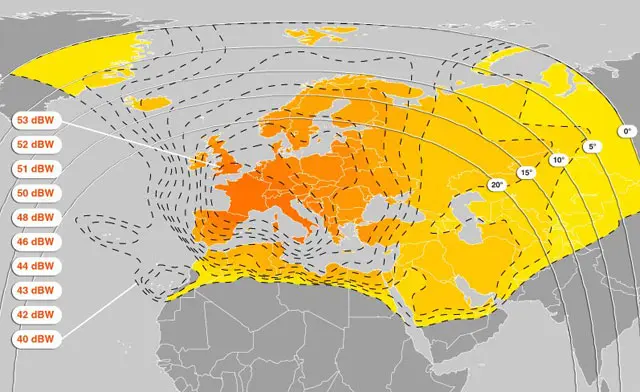
West: British Isles to the Caspian Sea
-
East: Anatolia to China
-
Additional: India, Thailand, Malaysia, Indonesia
-
-
Population Reach: Over 5 billion people
Development and Testing
Türksat 6A’s development involved significant domestic expertise. TAI handled the satellite’s structure, thermal control, propulsion, and mechanical ground equipment.
TÜBİTAK Uzay and TAI collaborated on software for onboard data handling and command control.
Assembly and testing occurred at TAI’s Satellite Assembly Integration and Test Facility in Ankara, training a new generation of Turkish engineers and fostering innovation. 🛠️
Services and Applications 📡🌐
Broadcasting Excellence
Türksat satellites power national and international television and radio channels, including TRT, ATV, Kanal D, and Show TV.
The Türksat Channel Update System (TKGS) simplifies channel scanning for compatible receivers, enhancing user experience. 📺
Broadband and Data Services
Türksat’s VSAT system provides audio, data, internet, intranet, e-health, e-education, emergency communication, VPN, and multimedia services.
This system is critical in regions with limited terrestrial infrastructure, offering cost-effective solutions for public and private sectors. 🌍
Military Communications
The X-band transponders in Türksat 6A ensure secure, high-speed communication for the Turkish Armed Forces, enhancing national security. 🛡️
Global Impact and Future Prospects 🌟
Türksat’s satellites have transformed Turkey into a regional hub for satellite communications, fostering economic growth, digital inclusion, and international collaboration.
The successful launch of Türksat 6A not only strengthens Turkey’s technological independence but also expands its influence to over 5 billion people across three continents.
This achievement paves the way for future innovations, including potential advancements in satellite miniaturization, AI-driven communication systems, and sustainable space technologies. 🚀
Looking ahead, Türksat aims to further enhance its satellite fleet, focusing on higher bandwidth, improved coverage, and eco-friendly designs.
By investing in domestic talent and international partnerships, Türksat is poised to remain a leader in the global satellite industry, connecting the world one signal at a time. 🌐
Entering accurate frequency data, including symbol rate and Forward Error Correction, ensures receivers capture channels correctly. Even slight errors in these parameters can lead to missing channels or weak signals.
Modern receiver tools, such as auto-scan and blind scan, help users find channels efficiently, but the most reliable results come from combining these tools with precise manual tuning.
The quality of the installation plays a key role in signal stability. Proper dish alignment, secure mounting, and high-quality cables all contribute to stronger, uninterrupted reception.
Regular maintenance ensures long-term performance and prevents sudden drops in signal quality. Attention to these details enhances overall viewing reliability.
With accurate frequency knowledge and proper installation, viewers experience a consistent and enjoyable satellite broadcast environment.
Entering accurate frequency data, including symbol rate and Forward Error Correction, ensures receivers capture channels correctly. Even slight errors in these parameters can lead to missing channels or weak signals.
Modern receiver tools, such as auto-scan and blind scan, help users find channels efficiently, but the most reliable results come from combining these tools with precise manual tuning.
The quality of the installation plays a key role in signal stability. Proper dish alignment, secure mounting, and high-quality cables all contribute to stronger, uninterrupted reception.
Regular maintenance ensures long-term performance and prevents sudden drops in signal quality. Attention to these details enhances overall viewing reliability.
With accurate frequency knowledge and proper installation, viewers experience a consistent and enjoyable satellite broadcast environment.
Entering precise frequency parameters in the receiver, including symbol rate, polarization, and Forward Error Correction, guarantees better signal strength and fewer tuning problems. Accurate configuration makes channel scanning faster and more reliable.
Equipment setup plays an essential role, as proper dish alignment and high-quality cables help maintain a strong signal even in challenging weather conditions. Maintenance of these components ensures long-term stability.
By combining accurate technical updates with proper installation, viewers can enjoy high-quality broadcasts and consistent access to all channels without interruption.
Entering precise frequency parameters in the receiver, including symbol rate, polarization, and Forward Error Correction, guarantees better signal strength and fewer tuning problems. Accurate configuration makes channel scanning faster and more reliable.
Equipment setup plays an essential role, as proper dish alignment and high-quality cables help maintain a strong signal even in challenging weather conditions. Maintenance of these components ensures long-term stability.
By combining accurate technical updates with proper installation, viewers can enjoy high-quality broadcasts and consistent access to all channels without interruption.
Correctly applying the frequency, symbol rate, and Forward Error Correction values ensures optimal performance and reduces common reception problems. Accurate tuning makes channel restoration quick and efficient, improving both picture and sound quality.
Additionally, proper dish alignment and high-quality cables enhance signal strength and stability. When these elements are combined, viewers experience reliable broadcasting and long-term satisfaction.