Correctly entering technical parameters into the receiver greatly reduces the likelihood of reception issues. By ensuring the frequency, symbol rate, polarization, and error correction values are accurate, viewers can achieve reliable channel scanning and improved signal stability. This careful attention to detail enhances the overall viewing experience.
The effectiveness of these settings, however, relies heavily on the installation quality of the satellite equipment. Proper dish positioning and high-quality cabling minimize signal loss and maintain stable connections. Even minor installation improvements can significantly enhance reception levels.
With the right technical data and a well-installed satellite system, viewers can enjoy uninterrupted broadcasts and faster channel restoration. This combination ensures a smooth and consistent experience across all satellites and channels.
Entering the correct receiver data is essential for successful channel scanning. Each parameter—frequency, symbol rate, and Forward Error Correction—must be programmed precisely to ensure strong reception and reduce technical issues. Proper configuration helps viewers enjoy smoother performance and prevents disruptions during channel searches.
Beyond tuning, the stability of the signal is also determined by the physical installation of the equipment. A properly aligned dish, secure mounting, and high-quality cables ensure that the signal remains strong even when weather conditions fluctuate. Routine maintenance keeps the system performing at its best.
When viewers combine accurate frequency updates with a well-maintained installation, they unlock the full potential of their satellite systems. This balanced approach guarantees clearer reception, stronger signals, and seamless access to all updated channels.
Applying the correct receiver settings ensures that the scanning process identifies all channels accurately. The frequency, symbol rate, and Forward Error Correction must all match the latest parameters to achieve optimal performance. When configured correctly, the system delivers strong, stable, and clear signal reception.
However, accurate tuning is only part of the equation. The installation quality—including dish alignment, cable condition, and receiver maintenance—has a direct impact on signal strength. A well-adjusted system minimizes interference and helps maintain consistency even during weather changes.
With a blend of updated frequency guidance and technically sound installation, satellite viewers can enjoy uninterrupted access to hundreds of channels. By following the latest data and performing proper adjustments, users ensure the best viewing experience with minimal effort.
Applying the correct receiver settings ensures that the scanning process identifies all channels accurately. The frequency, symbol rate, and Forward Error Correction must all match the latest parameters to achieve optimal performance. When configured correctly, the system delivers strong, stable, and clear signal reception.
However, accurate tuning is only part of the equation. The installation quality—including dish alignment, cable condition, and receiver maintenance—has a direct impact on signal strength. A well-adjusted system minimizes interference and helps maintain consistency even during weather changes.
With a blend of updated frequency guidance and technically sound installation, satellite viewers can enjoy uninterrupted access to hundreds of channels. By following the latest data and performing proper adjustments, users ensure the best viewing experience with minimal effort.
Tuning the satellite receiver with the correct parameters is key to avoiding common issues such as weak signals, incomplete scanning, or missing channels. Accurate entry of the frequency, symbol rate, and Forward Error Correction ensures a strong connection and stable performance. Proper configuration is essential for receiving clear and uninterrupted broadcasts.
The quality of the installation also plays a crucial role in the system’s overall performance. A precisely aligned dish, secure mounts, and well-insulated cables significantly improve signal strength and reduce interference. Maintaining these components helps achieve consistent reception regardless of environmental conditions.
Combining precise technical data with a proper installation setup results in a fully optimized satellite experience. Viewers benefit from strong, stable signals and seamless access to all channels, ensuring a more enjoyable viewing environment
Entering the correct receiver data is essential for successful channel scanning. Each parameter—frequency, symbol rate, and Forward Error Correction—must be programmed precisely to ensure strong reception and reduce technical issues. Proper configuration helps viewers enjoy smoother performance and prevents disruptions during channel searches.
Beyond tuning, the stability of the signal is also determined by the physical installation of the equipment. A properly aligned dish, secure mounting, and high-quality cables ensure that the signal remains strong even when weather conditions fluctuate. Routine maintenance keeps the system performing at its best.
When viewers combine accurate frequency updates with a well-maintained installation, they unlock the full potential of their satellite systems. This balanced approach guarantees clearer reception, stronger signals, and seamless access to all updated channels.
Correctly entering each parameter into the receiver reduces the chances of encountering glitches, missing channels, or weak signals. Frequencies, symbol rates, and polarization values must be aligned with the broadcaster’s latest configuration to ensure effective signal capture. This process significantly improves reception quality.
In addition to technical parameters, the setup of the satellite dish plays a crucial role in signal performance. Proper alignment toward the satellite, durable cabling, and well-maintained equipment help ensure stable reception even during adverse weather conditions. Each component contributes to a stronger and more consistent signal.
When users combine updated frequency data with a properly installed satellite system, they achieve a balanced and optimized viewing experience. Equipped with accurate information and effective installation, viewers can resolve issues quickly and maintain reliable access to all their preferred channels.
The Astra 1 satellite, positioned at 19.2º East, stands as a cornerstone of satellite broadcasting, delivering a vast array of television and radio services to millions across Europe and parts of North Africa.
Operated by SES, a global leader in satellite communications, Astra 1 is renowned for its ability to transmit over 1,150 channels, making it a pivotal hub for entertainment and connectivity.
This article delves into the unique features of Astra 1, exploring its history, launch milestones, coverage areas, technological advancements, and its critical role in shaping the viewing experience for millions.
A Celestial Gateway: Overview of Astra 1
Astra 1, also known as Astra 19.2ºE, refers to a cluster of satellites stationed at the 19.2º East orbital slot in the Clarke Belt, managed by SES, headquartered in Betzdorf, Luxembourg.
This orbital position was the first utilized by SES, initially named Astra 1, but rebranded in 2008 to Astra 19.2ºE to distinguish it from other Astra orbital slots.
Operating in the Ku-band frequency range (10.70–12.70 GHz), Astra 1 delivers a mix of free-to-air and encrypted television and radio services.
Astra 1 is a powerhouse in European broadcasting, serving over 118.4 million households through 147 transponders (145 in Ku-band and 2 in Ka-band), supporting direct-to-home (DTH), cable, and Internet television distribution.
It is a pioneer in high-definition television (HDTV), broadcasting over 40 HD channels via platforms like HD+ in Germany, elevating the visual quality for viewers.
Its strategic position and robust infrastructure make it a go-to satellite for broadcasters and viewers alike.
A Journey Through Time: History and Launch of Astra 1
The Astra 1 saga began with the launch of Astra 1A on December 11, 1988, marking Europe’s first dedicated direct-to-home (DTH) satellite.
Equipped with 16 transponders, it commenced broadcasting in February 1989, carrying iconic channels like Sky Television and MTV Europe.
This was followed by Astra 1B in 1991 and Astra 1C in 1993, introducing SES’s innovative “co-location” strategy, where multiple satellites are positioned within a 150 km orbital cube to ensure redundancy and flexibility.
In 1994, Astra 1D was launched, initially intended for digital broadcasting but adapted for analog due to market demand. The transition to digital began with Astra 1E in 1995, setting the stage for subsequent satellites like Astra 1KR, 1L, 1M, and 1N.
The latest addition, Astra 1P (also known as SES-24), was launched on June 20, 2024, via a SpaceX Falcon 9 rocket. As the most advanced satellite in this slot, Astra 1P boasts 80 Ku-band transponders capable of delivering 500 HDTV channels.
In February 2025, all services from older satellites (Astra 1KR and 1L) were migrated to Astra 1P, paving the way for their retirement.
Spanning Continents: Coverage Areas of Astra 1
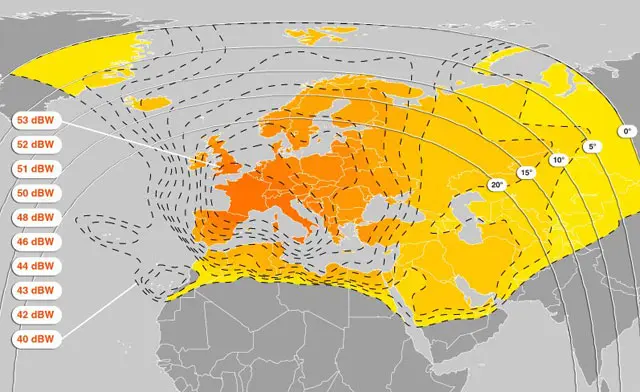
Astra 19.2ºE is strategically positioned to serve a vast geographical footprint, primarily focusing on Europe and extending to parts of North Africa. Key regions include:
-
Germany, Austria, and Switzerland: Serving 42 million TV households, Astra 1 is a market leader in Germany, powering platforms like HD+ and ZDF with robust channel offerings.
-
France: Reaching 17.5 million households through providers like CANAL+ and Orange, it supports both free and pay-TV services.
-
Spain: Covering 7.5 million households via Movistar+ (Telefonica), it delivers international and local channels.
-
North Africa: Providing coverage to countries like Morocco, Algeria, and Tunisia, where it supports DTH services.
-
Other Regions: Including Belgium, the Netherlands, Poland, parts of Italy, and Eastern Europe, with signal strength varying by location.
Astra 1 utilizes multiple beams, such as the wide European beam for Northern and Central Europe and targeted beams for Spain and Southern Italy. Its proximity to Astra 23.5ºE allows viewers to receive channels from both positions using a single dish with a Duo LNB, enhancing installation efficiency.
Cutting-Edge Innovation: Technical Features of Astra 1
Astra 1 is distinguished by its advanced technology, setting benchmarks in satellite broadcasting:
-
High-Definition Broadcasting: A trailblazer in HDTV, Astra 19.2ºE delivers over 40 HD channels, with platforms like HD+ offering premium visual experiences.
-
Co-Location Strategy: Multiple satellites in the same orbital slot ensure seamless service continuity and resilience against technical failures.
-
Astra 1 Sports Platform: Launched in 2022, this service optimizes sports content delivery, supporting high-quality live broadcasts across Europe.
-
Efficient Bandwidth Utilization: The Ku-band transponders, especially on Astra 1P, maximize channel capacity, enabling the transmission of hundreds of HD and SD channels.
-
Digital and Encrypted Services: Supports a mix of free-to-air channels and encrypted services via smartcards, catering to diverse viewer preferences.
The introduction of Astra 1P in 2024 marked a leap forward, with its enhanced transponder capacity and energy-efficient design, ensuring long-term sustainability and superior performance.
A Viewer’s Paradise: Channels and Services
Astra 19.2ºE hosts a staggering 1,150+ television and radio channels, making it a viewer’s paradise. Key offerings include:
-
German Market: Channels like RTL, ProSieben, Sat.1, and public broadcasters ARD and ZDF, alongside HD+ exclusives like RTL UHD.
-
French Market: CANAL+ bouquet, TF1, M6, and free-to-air channels like France 2 and France 3.
-
Spanish Market: Movistar+ channels, including sports, movies, and international content like BBC World News.
-
International Channels: A mix of news (e.g., CNN, Al Jazeera), entertainment (e.g., MTV), and niche channels for expatriate communities.
-
Radio Services: Hundreds of radio stations, including BBC Radio and regional European broadcasts.
The satellite supports both standard-definition (SD) and high-definition (HD) channels, with a growing emphasis on ultra-high-definition (UHD) content, particularly for sports and premium movies.
Tips for Receiving Astra 1
To access Astra 1’s vast channel lineup, proper equipment and setup are essential. Here are key tips:
-
Dish Size: A 60-80 cm dish is sufficient for Central Europe (e.g., Germany, France). In fringe areas (e.g., North Africa or Eastern Europe), a 90-120 cm dish is recommended.
-
Dish Alignment: Use a satellite finder or app (e.g., DishPointer) to align your dish to 19.2ºE, ensuring a clear line of sight.
-
LNB Selection: A Universal Ku-band LNB (9.75/10.6 GHz) is ideal. For multi-satellite reception, use a Monoblock or Duo LNB.
-
Receiver Compatibility: Ensure your receiver supports DVB-S/S2 standards for SD, HD, and UHD channels. Smartcards may be required for encrypted services.
-
Signal Check: Aim for 70%+ signal quality on your receiver’s setup menu to avoid disruptions.
-
Weather Considerations: Secure the dish to withstand rain or wind, as Ku-band signals can be affected by adverse weather.
The Future of Astra 1
Astra 19.2ºE continues to evolve, with SES investing in next-generation satellites to meet the demand for high-quality content.
The deployment of Astra 1P underscores SES’s commitment to sustainability, with its all-electric propulsion system reducing launch costs and environmental impact.
Future advancements may include broader UHD adoption, enhanced interactive services, and integration with hybrid satellite-Internet television platforms.
As streaming services grow, Astra 1 remains a vital complement, offering reliable DTH broadcasting to areas with limited internet connectivity.
Astra 1 at 19.2ºE is more than a satellite—it’s a gateway to entertainment, connecting over 118 million households with a rich tapestry of television and radio content.
From its pioneering launch in 1988 to the cutting-edge Astra 1P in 2024, it has shaped Europe’s broadcasting landscape with its extensive coverage, technological innovation, and diverse channel offerings.
Whether you’re in Germany watching HD+ or in North Africa tuning into free-to-air channels, Astra 1 delivers unmatched reliability and quality.
By following the reception tips and staying updated with transponder settings, you can unlock the full potential of this broadcasting beacon and immerse yourself in a world of entertainment.
Accurate frequency entry ensures receivers lock onto channels effectively, delivering clear and stable signals. Symbol rate, polarization, and Forward Error Correction values must be configured precisely to avoid common tuning issues.
Advanced scanning tools in modern receivers simplify the process, but manual adjustments remain the most reliable method for optimal performance. Combining automatic and manual techniques often yields the best results.
Antenna alignment and quality installation are equally critical. A well-positioned dish and durable cables prevent signal drops and interference. Minor adjustments can significantly improve overall reception quality.
Routine maintenance of the system ensures long-term performance and reduces the likelihood of disruptions. Even small improvements in installation often result in noticeable gains in stability and signal clarity.
With the right combination of accurate frequency data and solid technical installation, viewers enjoy reliable access to all channels, high-quality visuals, and uninterrupted audio.
This approach ensures a seamless, enjoyable, and professional satellite viewing experience that adapts to all future frequency updates.
Accurate frequency entry ensures receivers lock onto channels effectively, delivering clear and stable signals. Symbol rate, polarization, and Forward Error Correction values must be configured precisely to avoid common tuning issues.
Advanced scanning tools in modern receivers simplify the process, but manual adjustments remain the most reliable method for optimal performance. Combining automatic and manual techniques often yields the best results.
Antenna alignment and quality installation are equally critical. A well-positioned dish and durable cables prevent signal drops and interference. Minor adjustments can significantly improve overall reception quality.
Routine maintenance of the system ensures long-term performance and reduces the likelihood of disruptions. Even small improvements in installation often result in noticeable gains in stability and signal clarity.
With the right combination of accurate frequency data and solid technical installation, viewers enjoy reliable access to all channels, high-quality visuals, and uninterrupted audio.
This approach ensures a seamless, enjoyable, and professional satellite viewing experience that adapts to all future frequency updates.
Entering accurate frequency data, including symbol rate and FEC, ensures receivers capture channels correctly. Even slight errors in these parameters can lead to missing channels or weak signals.
Modern receiver tools, such as auto-scan and blind scan, help users find channels efficiently, but the most reliable results come from combining these tools with precise manual tuning.
The quality of the installation plays a key role in signal stability. Proper dish alignment, secure mounting, and high-quality cables all contribute to stronger, uninterrupted reception.
Regular maintenance ensures long-term performance and prevents sudden drops in signal quality. Attention to these details enhances overall viewing reliability.
With accurate frequency knowledge and proper installation, viewers experience a consistent and enjoyable satellite broadcast environment.